Something most senior couples therapists in New York will tell you in private and almost never put on a website: the strongest predictors of whether online couples therapy NYC works are the clinician’s expertise and the fit between partners and the model. The couple also needs to show up, week after week, long enough to let the work compound. Senior judgment plus the right method are non-negotiable. They are also useless if the couple keeps canceling. This raises an inconvenient question for the old therapy-office assumption. It applies even to therapists like me who spent years believing the office mattered most. If the office is one of the largest predictors of cancellation, what is the office doing for the clinical work itself?
What this article covers about online couples therapy in NYC
A lot has changed since online couples therapy was treated as the snow-day backup plan. Research has moved. Many couples have not had time to catch up.
-
Recent meta-analyses show that video-delivered couples therapy produces outcomes equivalent to office-based work. This includes a 2021 review of 47 between-group studies and the 2024 Norwegian Gottman trial of 490 participants.
-
Therapeutic alliance is one of the strongest predictors of therapy success. It develops through HIPAA-compliant video when the clinician tracks online micro-reactions.
-
For Manhattan and Brooklyn couples, online couples therapy NYC removes the friction that sabotages attendance. More sessions happen, and repair attempts stop slipping to the bottom of the calendar.
-
Online couples work is not appropriate for every couple. Active violence, acute crisis, and certain trauma presentations need a different level of care, and a thorough intake clarifies fit.

Why is online couples therapy in NYC no longer the compromise option?
The old New York story was simple. Serious couples therapy happened in an office. Maybe Midtown, maybe SoHo. Maybe a quiet brownstone floor in Park Slope, where you hoped not to pass someone from your kid’s school on the stairs.
Online therapy was the lesser version. It served as the backup for a storm, a stalled L train, or one partner stuck in a FiDi tower after a closing ran late.
That belief made sense for a while. Then the research stopped cooperating.
What the research actually found
A 2021 meta-analysis of 47 between-group studies compared video-delivered psychotherapy with face-to-face care. Pre-to-post effects for video therapy were large, with g = 0.99, and outcomes were statistically equivalent across common mental health conditions, including anxiety, depression, and PTSD. The gap researchers expected to find was not there.
A 2022 systematic review of 12 RCTs covered 931 participants. It found no significant differences between telehealth and face-to-face psychotherapy at post-treatment, nor at 3, 6, or 12 months out. The 2024 CMAJ systematic review reached a similar conclusion for therapist-guided remote CBT. Remote care performed comparably to office-based care, and adherence was often similar or better.
For relationship therapy, the better question has changed. It is no longer, “Does online therapy work at all?” The sharper question now is: for whom, under what conditions, and with which licensed therapist does online couples work best?
That shift matters. Couples who delayed treatment because virtual couples therapy felt like second place may be using an old map for a new landscape.
Couples therapy can benefit all types of intimate relationships, regardless of sexual orientation or marital status, and is not reserved for married couples on the edge of separation. Many couples seek therapy for communication patterns, emotional pain, sex therapy concerns, trust injuries, premarital counseling, new-parent stress, and significant life transitions that strain relationships long before anyone has said the word divorce.
Book Your First Session with Travis →
What does Gottman research say about online couples therapy?
Couples who care about evidence often ask a sharper version of the question. Fine. Video therapy may work for individual therapy, mood disorders, or general mental health services. Does it work for couples?
That is where Gottman Method research matters most.
The Gottman Method, developed by psychologists John and Julie Gottman, focuses on improving relationships by identifying and changing patterns that lead to divorce. Friendship, conflict repair, trust, and commitment are the foundational elements of a healthy relationship in this model.
Key Gottman studies on video-delivered couples therapy
In 2024, Rune Zahl-Olsen and colleagues published a study in the Journal of Marital and Family Therapy. It examined the Gottman Seven Principles Program with 490 participants. Online and office-based groups improved comparably in relationship quality, and gains held at six-month follow-up.
The method did not lose its spine on video.
A 2024 pilot RCT by Irvine, Peluso, Benson, Gottman, and Gottman in The Family Journal examined Gottman Method Couples Therapy for affair recovery. Significant improvements in trust and relationship distress emerged in the GMCT condition, including when care was delivered remotely. For couples rebuilding trust after infidelity, structure matters. The nervous system is not fond of improvisation when betrayal is on the table.
Book Your First Session with Travis →
Travis Atkinson has been a Certified Gottman Method Couples Therapist since 2006. In online couples therapy at Loving at Your Best, Gottman work maps criticism, contempt, defensiveness, and stonewalling. It identifies flooding, repair attempts, and the moments where one or both partners lose regulation before the conversation can begin.
The four horsemen sound dramatic. In practice, they are ordinary. A half-laugh at the wrong moment. Sighing before answering. One partner saying, “I’m not doing this right now,” while closing a laptop a bit too hard.
Online couples therapy sessions allow those moments to be seen in real time. A couples therapist trained in Gottman work is not watching for theatrical conflict. He is watching for the small turn away.
For couples seeking Gottman couples therapy NYC, the lesson is not that a method solves everything. It is that evidence-based couples work translates well when the clinician knows how to use the format.
Learn more about Gottman Method couples therapy.
Can couples build trust with a therapist through a screen?
This is the concern people whisper after the research has been explained.
Will it feel flat? Could the therapist miss something important? Are we capable of trusting someone we have never sat across from in a room?
Reasonable questions, all of them.
A 2022 randomized controlled trial by Kysely and colleagues in Frontiers in Psychology compared face-to-face couples therapy with videoconferencing delivery. Working Alliance Inventory scores were statistically equivalent across formats, and alliance strengthened over time in both groups. The therapeutic alliance did not depend on sharing the same air.
Research also confirms that videoconferencing is as effective as traditional face-to-face sessions for improving relationship satisfaction and building therapeutic bonds. In couples counseling, that bond is not decorative. It is the container that lets partners say the thing they have been editing for months.
The online version has its own texture.
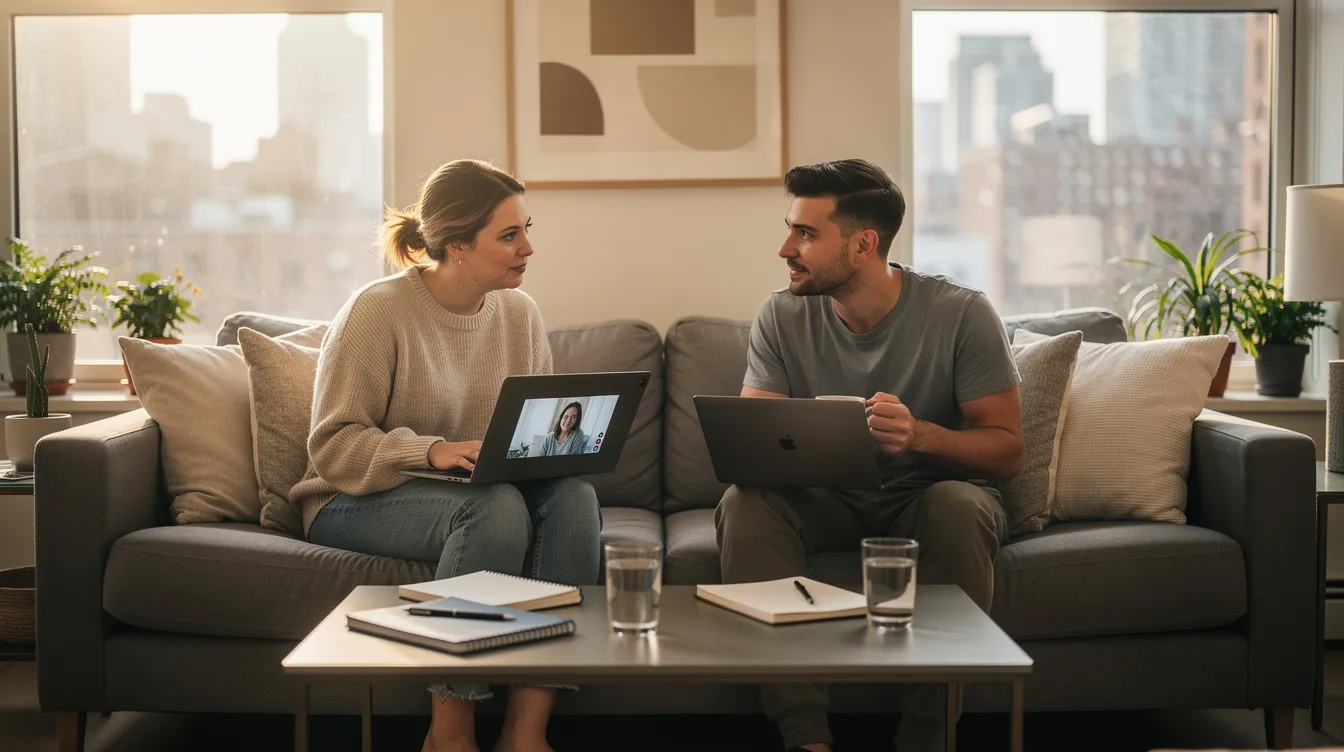
One partner sits at the kitchen table, earbuds in, a dog asleep under the chair. The other sits in the bedroom because the apartment is 700 square feet and privacy requires creativity. Eight minutes in, the therapist names the cycle: “When you feel dismissed, you protest. When you protest, your partner hears attack and disappears.”
A shoulder drops a quarter inch. Someone blinks twice, looks down, then looks back at the screen.
Nobody announces trust. It appears as the room gets quieter.
Why the home environment can support therapeutic trust
Discussing sensitive topics in a familiar home environment may enhance emotional safety for partners. A virtual format may feel less intimidating for partners hesitant about traditional in person couples therapy. Some couples disclose faster from their own kitchen than from a waiting room. In a waiting room, they are pretending not to hear the couple arguing behind the white-noise machine.
Video is not a substitute for clinical judgment. The medium is not the barrier many people assume, though. Therapist competence and fit matter more than the platform. When evaluating a couples therapist, qualifications matter. Look for a licensed marriage and family therapist, a licensed marriage counselor, or a clinical social worker who works specifically with romantic relationships.
A master’s degree alone is not the whole story. Specialized training in marriage therapy, family therapy, emotionally focused couples therapy, Schema Therapy, sex therapy, and the Gottman Method often matters more than a broad claim of “relationship counseling.”
Why does online couples therapy NYC fit Manhattan and Brooklyn couples better than office-based care?
The problem is rarely one calendar.
It is two calendars, two nervous systems, one relationship, and a city that adds friction for sport.
A 7 a.m. East Coast call with London. The 6 train running local without warning. Co-op board emails at 10 p.m. with a tone suggesting civilization may collapse if the hallway paint color is not approved by midnight. Kid pickup in Brooklyn. One SoHo office. One partner sits in a Manhattan high-rise. The other is in a brownstone near Prospect Park, both trying to make a 6:30 appointment as if the F train has signed an emotional growth contract.
Why New York geography makes online sessions more practical
Virtual couples therapy Manhattan and online couples therapist Brooklyn searches have climbed for a reason. Participating in online couples therapy eliminates commuting hurdles and maximizes scheduling flexibility for couples in New York City. Virtual sessions remove the stress of unpredictable transit delays. Partners start a session feeling somewhat human, which has real consequences for the clinical work itself.
A couple arriving late, flooded, apologizing, hungry, and resentful has already spent part of the hour before the therapy session begins. Online couples work minimizes logistical barriers and supports continuity of care during changing life circumstances. Geographic limits disappear too, which opens the door to specialists across New York State, not only the right therapist within a twelve-block radius.
Navigating the New York therapy landscape
The New York therapy landscape now includes everything from large telehealth platforms with unlimited messaging and subscription plans, to university-affiliated medical centers, to specialized boutique practices. Each serves different needs. Subscription platforms tend to fit couples wanting general support and quick matching. For complex medical history requiring coordinated mental health services, a university-affiliated medical center may be the right level of care. Senior boutique practices fit couples who want deep specialization, continuity with one clinician, and the kind of clinical depth that large platforms cannot economically deliver.
Virtual platforms can also provide anonymity, reducing the risk of run-ins with acquaintances in physical waiting rooms or the odd experience of walking past your therapist’s office while holding groceries and trying to look emotionally well-adjusted.
Couples therapy NYC is often less about willingness and more about friction. Many couples arrive years late not because they never cared. They tried to begin treatment, then the commute, the childcare, the privacy concerns, and everyday life won.
A familiar home setup also helps some online couples move faster. Not because home is always peaceful. Anyone who has done a therapy session while a neighbor’s radiator bangs like a small courtroom knows better. Partners often speak with less performance when they are not in a borrowed room, though.
Online marriage counseling NYC, online couples counseling, and virtual couples therapy are not shortcuts around the healing process. They are a way to keep the healing process from being devoured by logistics.
How does virtual couples therapy save time for busy professionals?
A 50-minute appointment becomes a two-hour block. Add the elevator, the F train, the Midtown lobby wait, and the reverse trip home. Online couples work is the 50 minutes itself, plus the time to close the office door and make sure Slack is not still pinging.
Across a year of weekly sessions, research indicates that online couples therapy offers significant time savings by eliminating long commutes. For dual-career couples, that time recovery can be the difference between consistent weekly sessions and a brave plan that collapses by month two.
Online therapy offers flexible and accessible ways for couples to meet with a licensed therapist from almost anywhere. Loving at Your Best is more bounded than that phrase suggests. Sessions require both partners to be physically located in New York, Florida, or Vermont during care. The scheduling advantage remains substantial.
There is also the small absurdity of two executives sending each other Outlook invites titled “argue less” while an assistant color-codes the recurring appointment. If that is what gets the relationship protected, fine. Let the calendar earn its keep.
When is online couples therapy NYC more effective than office-based care?
The field has made a quiet pivot.
Researchers are no longer asking only whether online care is “as good.” They are asking when access, adherence, and lower friction make care more likely to work at all.
The 2024 CMAJ review of remote CBT found comparable outcomes and adherence that was often better or similar to office-based care. The 2022 systematic review of 12 RCTs reached the same conclusion. Guided care, meaning care with active clinician involvement, tends to produce stronger results than self-guided tools.
Consider what that looks like in practice. A couple cancels 6 of their first 12 in-person sessions because of competing demands. They switch to online sessions and attend 11 of the next 12. That is not a therapy success story. It is a scheduling story. The scheduling story is where the therapy story begins, though, because the work cannot do anything if the couple is not in the room.
More sessions happen. Fewer gaps open during travel, parenting weeks, trial separations, or high-pressure work seasons. A hesitant partner who would never sit in a waiting room may agree to click a HIPAA-compliant link from a closed office door.
Who benefits most from virtual couples therapy
Online therapy can be as effective as in person couples therapy for various mental health conditions, including the relationship issues couples bring to treatment, such as communication, emotional disconnection, and intimacy. Online couples work helps partners at any stage. Some want to strengthen the relationship before patterns harden. Others are already facing significant challenges.
The American Association for Marriage and Family Therapy reports that over 97% of surveyed couples felt they got the help they needed. Outcome research on Emotionally Focused Therapy has shown recovery rates from relationship distress in the range of 70 to 75 percent in well-conducted trials. These numbers are not guarantees. Relationships do not come with warranty cards. The data does push back against the bleak private thought many couples carry, though: maybe we waited too long.
Couples counseling can help people in all types of intimate relationships, regardless of sexual orientation or marital status, by improving communication and conflict resolution skills. Married couples, unmarried partners, LGBTQ+ couples, couples with blended family dynamics, and partners navigating questions of sexual orientation within the relationship may all benefit from a person centered approach and a clear treatment plan.
Some couples also need support around ADHD in relationships, perinatal transitions, intimacy after children, recovering from emotional affairs, or discernment about whether to stay. Others need conflict resolution skills, coping skills, and help rebuilding emotional connections after years of parallel living.
The medium does not make those conversations simple. It makes them harder to postpone.

Book Your First Session with Travis →
When is in person therapy still the better choice?
Online couples therapy NYC is not the right level of care for every relationship.
Active intimate partner violence or credible safety threats call for more immediate local support. Acute suicidality, active psychosis, or severe substance instability requires in-person crisis care. Severe dissociative and somatic trauma presentations need coordinated mental health services. Certain trauma work requires body-based intervention that video does not serve well.
Practical barriers matter too. Unstable internet, no private space at home, a partner who feels unsafe speaking freely indoors, or intense activation from seeing oneself on screen can interfere with the work. A clinician should ask about these factors before agreeing to begin treatment.
Only one partner may want to enter a therapy room at first. Individual therapy can help that partner clarify choices, strengthen boundaries, and understand their own schemas. It is not the same as therapy for couples. The option can be useful when both you and your partner are not ready to sit together.
Group therapy for couples offers a collaborative environment where partners share experiences and work on communication and conflict resolution skills, sometimes leading to improved intimacy and relationship patterns. Loving at Your Best does not offer group therapy. The format suits some couples, though.
Other approaches may complement couples counseling. Dialectical behavior therapy can support emotional regulation when one or both partners struggle with intense reactivity. Acceptance and commitment therapy, sometimes searched as commitment therapy, helps partners act from values under stress. A family therapist may use these tools when family dynamics are part of the picture.
Good care includes saying no when no is the right answer.

What does online couples therapy NYC with a senior couples therapist look like in practice?
The intake email arrives with a secure link. Not much drama there. Couples therapy rarely begins with cinematic lighting.
One partner checks audio from a Brooklyn co-working space. The other sits in a Manhattan high-rise study, half-turned from the window. The city is doing what it does: sirens, glass, somebody honking as if honking has ever changed a human heart.
In the first therapy session, Travis listens for the pattern beneath the content. The fight may be about money, sex, parenting, emotional distance, or the renovation that somehow became a referendum on character. A treatment plan begins with the cycle: who pursues, who withdraws, who criticizes, who goes numb. Who repairs, and who refuses repair because repair feels like surrender.
Travis Atkinson’s integrated clinical approach
Loving at Your Best offers online couples therapy services for clients physically located in New York, Florida, or Vermont. Travis Atkinson, LCSW, LICSW, is a clinical social worker with nearly three decades of experience. His work integrates the Gottman Method, Emotionally Focused Therapy, and Schema Therapy for couples.
Emotionally focused therapy is a structured approach to couples counseling that helps partners build secure emotional connections by understanding and expressing emotional needs. The work often moves beneath the argument into the attachment fear — the unspoken beliefs that drive it: not mattering, being left, being too much, not being reached.
Schema Therapy and EFT in online work
Schema Therapy adds another layer. The model maps the emotional “modes” each partner shifts into under stress, the psychological states that take over when the higher mind has briefly left the building. A partner’s Detached Protector mode may look like indifference. The Demanding Parent mode often sounds like “why can’t you handle this?” Underneath, a Vulnerable Child mode may be driving the whole exchange from the back seat while both adults insist they are being rational.
Travis co-created Schema Therapy for Couples through close collaboration with Dr. Jeffrey Young beginning in 1994. Read more at the Schema Therapy Training Institute. He also co-created the first Emotionally Focused Therapy training video for same-sex couples with Dr. Sue Johnson, co-founded the International Society of Schema Therapy, and received its Honorary Lifetime Membership in 2020.
Credentials matter only if they change the hour in front of you.
In practice, that may mean Gottman structure for trust and repair, EFT for attachment patterns, and Schema Therapy for the lifetime emotional blueprint each partner brings into romantic relationships. A senior clinician knows when to teach, when to slow the room down, when to interrupt contempt, and when to let a silence do its work.
Read about Emotionally Focused Therapy for couples. For couples focused on rebuilding trust after infidelity, learn more about infidelity recovery.
Is hybrid couples therapy in NYC the future?
Mental health care has become less binary. By the mid-2020s, roughly 77% of psychologists were providing telehealth, and a 2025 review on hybrid mental health care suggested that some hybrid models may outperform single-modality care for certain conditions.
Some New York couples ask whether they can combine online couples therapy with in-person individual therapy, psychiatric care, medical care, or other supports. The answer is yes. One partner may see a local New York provider for mood disorders, trauma, or coping skills while the couples work happens online. Another couple may add sex therapy, family therapy, or medical consultation when relationship distress intersects with health, libido, or family dynamics.
Loving at Your Best provides couples work entirely online for clients physically located in New York, Florida, or Vermont. The choice to operate online-only is clinical, not logistical. It removes the variable most likely to defeat the work.
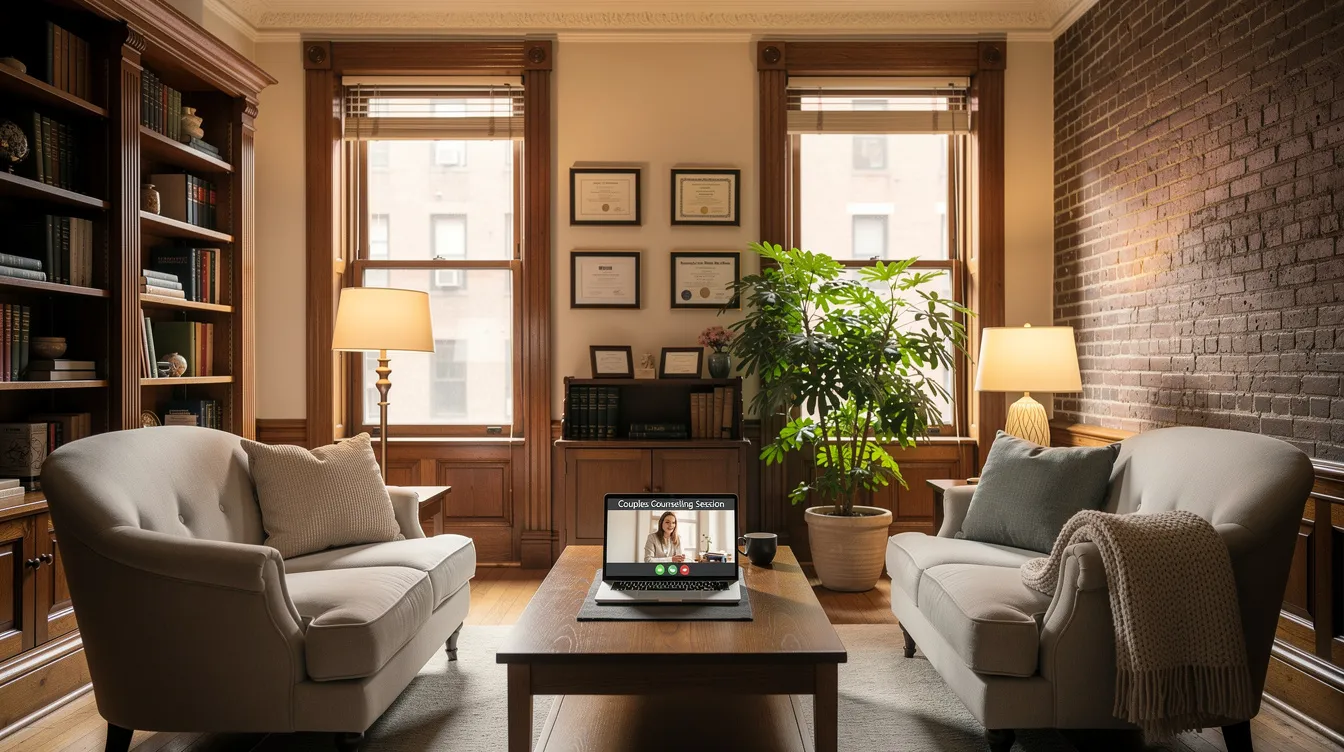
Frequently asked questions about online couples therapy in NYC
These are the questions high-functioning couples ask quietly. Sometimes one partner has already searched them at 1:13 a.m. with the brightness on the phone turned all the way down.
How do we know if online couples therapy in NYC is right for our relationship?
If both of you can find a private space, have stable internet, and want structured work on patterns like recurring conflict, distance, intimacy erosion, or trust injuries before they harden, online couples therapy NYC fits well. The bar to begin is lower than most couples assume. When there is active violence, immediate safety risk, acute psychosis, or crisis-level suicidality, higher-level local care comes first, full stop.
What makes virtual couples therapy different from talking things through on our own?
The 2 a.m. kitchen summit is doing its best, but it is not couples therapy. A seasoned couples therapist brings a framework for the pattern beneath the argument, interrupts escalation in real time, and holds both perspectives without collapsing into blame. Structured models such as the Gottman Method, EFT, and Schema Therapy give you a repeatable map instead of one cathartic talk followed by three weeks of careful silence.
What if one partner is more hesitant about online marriage counseling than the other?
Reluctance is one of the most common starting points, often loudest in the partner used to handling problems privately. A short, agreed-upon trial of four to six weekly sessions lets the hesitant partner evaluate fit without feeling trapped. The first appointment usually surfaces each person’s hopes and worries about marriage counseling itself, which becomes part of the work.
Does online couples therapy work for high-functioning professional couples?
Many of the strongest video therapy findings come from samples that resemble busy professional adults. For dual-career New York couples, reduced friction is what keeps engagement consistent, and consistency is one of the few client-side variables that meaningfully shapes outcomes. Travis works with executives, attorneys, founders, physicians, and other high-performing partners who tend to need direct structure, privacy, and a clinician who moves beneath performance.
How does Gottman couples therapy NYC translate to the online format?
The 2024 Norwegian RCT found that the Gottman Seven Principles Program produced equal outcomes online and in-office, with gains maintained at six-month follow-up. Gottman assessment, conflict mapping, repair work, four horsemen identification, and trust-building protocols translate cleanly to HIPAA-compliant video when delivered by a trained clinician.
What happens in the first few sessions of online couples therapy?
The opening phase usually includes a joint session to map patterns and goals, individual meetings to gather attachment history and relevant medical history, and a return to shared sessions with a clear treatment plan targeting cycles like criticism and withdrawal or recurring arguments about parenting, money, or intimacy. Couples leave early sessions with specific feedback and at-home practice, not vague communication advice copied from a self-help book.
Does Travis Atkinson take sides between partners?
Travis works from a pro-relationship stance, not a pro-one-partner stance. He listens for each partner’s story, triggers, strengths, and the moves that make repair harder. When one partner’s behavior carries more risk, accountability becomes part of the work, and the larger bond stays in view when it is safe to keep it there.
What does online couples therapy NYC cost, and do you accept insurance?
Loving at Your Best is a premium out-of-network practice. Most couples pay out of pocket and may use out-of-network insurance benefits when available for partial reimbursement. The practice does not accept insurance directly and does not participate with major insurance plans. Couples therapy cost details are listed on the scheduling page.
How do we get started with online couples counseling in NYC?
Read a brief overview of Travis’s clinical approach, confirm both partners will be physically located in New York, Florida, or Vermont during sessions, and use the Book Now or Book Your First Session link to choose a time that fits both calendars. Your first appointment is a conversation, not a verdict. Most couples leave it with a clearer sense of what is happening and whether the work fits their lives.
What comes next if you are ready to start online couples therapy NYC
The question we started with was a quiet one. If the office is one of the largest predictors of cancellation, what is the office doing for the clinical work itself? Most couples who reach out to Loving at Your Best have already answered it without naming the answer out loud. They have canceled enough sessions, postponed enough conversations, and watched enough next-weeks slide by to know the friction is not neutral.
Why removing friction changes the clinical outcome
Couples therapy works when expertise, model fit, and consistency are all in the room together. Online couples therapy NYC removes the one barrier most couples cannot quite outsmart: the structural friction that defeats their good intentions about three Wednesdays in. The Gottman protocols hold their shape on video. EFT still moves beneath the argument the way it does in a room. Schema work, with its mode mapping and chair work adaptations, names the lifetime pattern as clearly through a screen as across a couch. What changes is that the work happens, consistently, because the only thing between the two of you and the room is a closed door and a click.
Travis Atkinson sees a limited number of couples each week, with daytime and evening hours available. All sessions are online for couples physically located in New York, Florida, or Vermont. Both partners need a private space, stable internet, and roughly an hour they can protect on the calendar.
Most couples who contact us are not uncertain about whether they need help. They are uncertain about whether help is available in a form they can actually use. The research answers that. What remains is the decision.
When you are ready, the next step is straightforward. Use the Book Your First Session link below to choose a time that works for both schedules. Your first appointment is a conversation, not a verdict. You will leave with a clearer picture of what is actually happening in the relationship and whether the work fits your lives.
What we believed about the office was never quite right. What you protect — the hour together — is what does the work.
Book Your First Session with Travis →
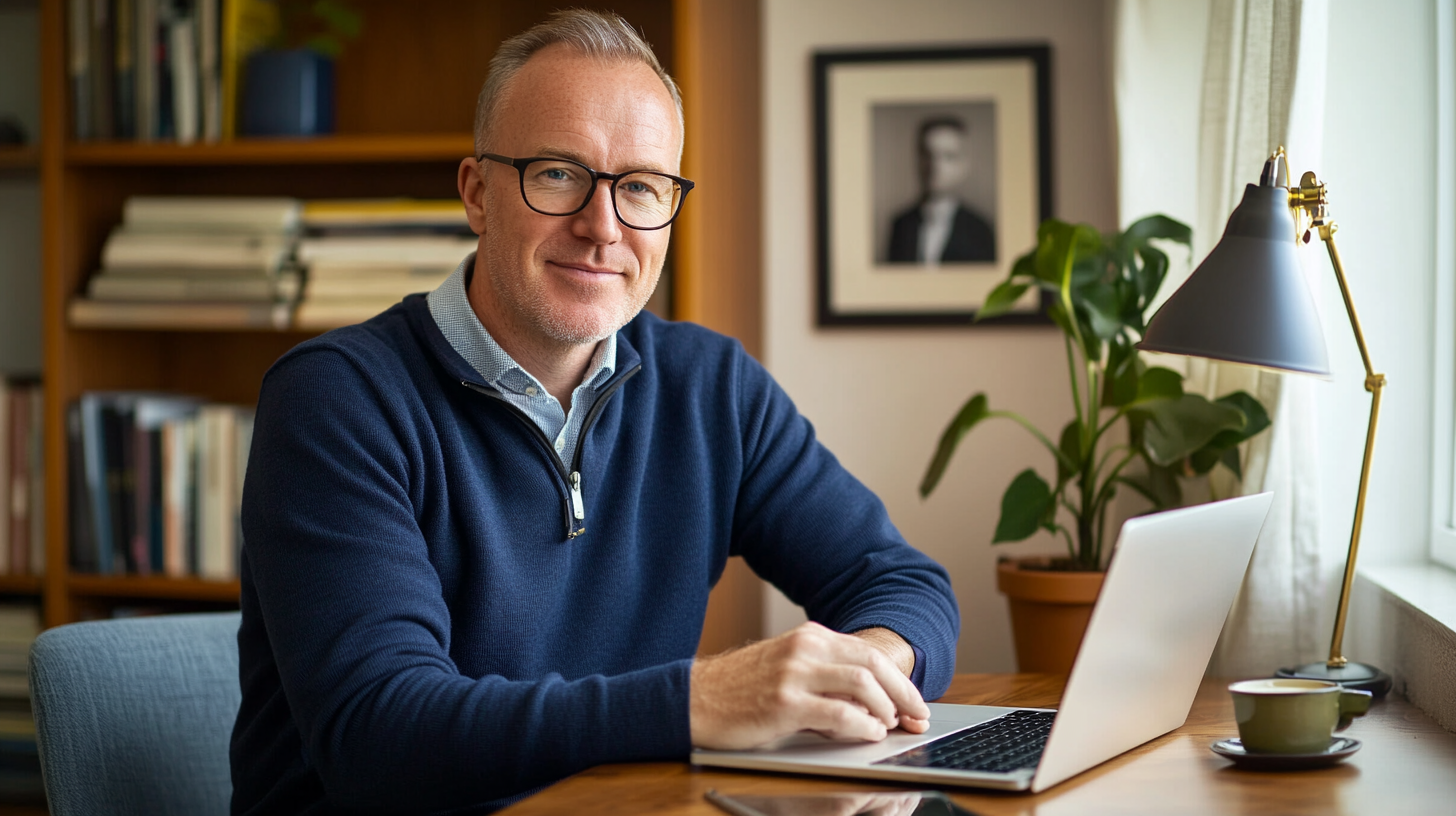
About Travis Atkinson
Travis Atkinson, LCSW, LICSW, is the founder of Loving at Your Best and has practiced couples therapy for nearly three decades. He is licensed in New York, Florida, and Vermont and works exclusively online with high-functioning professional couples in Manhattan, Brooklyn, and across both states.
Travis is a Certified Gottman Method Couples Therapist, certified in 2006, a co-creator of Schema Therapy for Couples through close collaboration with Dr. Jeffrey Young beginning in 1994, and the co-creator of the first Emotionally Focused Therapy training video for same-sex couples with Dr. Sue Johnson. He is a co-founder of the International Society of Schema Therapy and received the Society’s Honorary Lifetime Membership in 2020.
His integrative clinical model combines the Gottman Method, Emotionally Focused Therapy for couples, and Schema Therapy for couples, tailored to the patterns that show up in dual-career professional relationships.